More Birds Named for People
This is the next in a series of articles I am writing about the folks that have birds named for them. As you probably have heard, AOS plans to remove these names in the future and bury the history, good and bad, of the hobby we love. This is my effort to tell you a bit of that history before you have to dig farther to find it.
Bachman’s Sparrow
Bachman’s Sparrow (Peucaea aestivalis), also known as the pinewoods sparrow or oakwoods sparrow, is a small American sparrow endemic to the southeastern United States. It was named in honor of Reverend John Bachman.
John Bachman (1790 – 1874) was an American Lutheran minister, social activist, and naturalist who collaborated with John James Audubon to produce Viviparous Quadrupeds of North America and whose writings, particularly the Unity of the Human Race, were influential in the development of the theory of evolution. He was married to the painter Maria Martin. Maria Martin was an American watercolor painter and scientific illustrator. She contributed many of the background paintings for Audubon’s Birds of America and Viviparous Quadrupeds of North America. She was the only woman of the three principal assistants that Audubon employed at the time.
Bachman served the same Charleston, South Carolina, church as pastor for 56 years, but still found time to conduct natural history studies that caught the attention of Audubon and eminent scientists in England and Europe. He was a proponent of secular and religious education and helped found Newberry College and the Lutheran Theological Southern Seminary. He was elected an Associate Fellow of the American Academy of Sciences in 1845. Bachman was a social reformer who ministered to African-American slaves as well as white Southerners, and who used his knowledge of natural history to become one of the first writers to argue scientifically that blacks and whites are the same species.
Leconte’s Sparrow
Leconte’s Sparrow (Ammospiza leconteii) is one of the smallest New World sparrow species in North America. It is commonly mistaken for other small sparrows, such as Nelson’s Sparrow, Grasshopper Sparrow, and Henslow’s Sparrow. It breeds in central Canada and winters in the southeastern United States as far west as central Texas and as far north as central Illinois.
Leconte’s Thrasher
LeConte’s Thrasher (Toxostoma lecontei) is a pale bird found in the southwestern United States and northwestern Mexico. It prefers to live in deserts with very little vegetation, where it blends in with the sandy soils. LeConte’s thrashers are nonmigratory birds that reside in the same territory annually. The species has been decreasing in certain areas of its range, in particular California.
Both these birds were named for John Lawrence LeConte (1825-1883) an American entomologist, responsible for naming and describing approximately half of the insect taxa known in the United States during his lifetime, including some 5,000 species of beetles. He was recognized as the foremost authority on North American beetles during his career, and has been described as “the father of American beetle study”.
After graduating from medical college, John Lawrence LeConte made several trips west, including to California via Panama in 1849. While in San Francisco, he sent 10,000 beetles, preserved in ethanol, back to his father. Another 20,000 beetle specimens were lost in a fire in 1852. LeConte also traveled to Europe, Egypt, and Algiers. He spent two years exploring the Colorado River, was in Honduras for the building of the Honduras Interoceanic Railway, and in Colorado and New Mexico with the party surveying for the Kansas and Pacific Railway. He moved to Philadelphia in 1852, residing there for the rest of his life. LeConte was active in the scientific societies of his time, with stints as Vice-President of the American Philosophical
Society (1880–1883) and President of the American Association
for the Advancement of Science (1873). He was a founder of the
American Entomological Society and a charter member of the
National Academy of Sciences. Several hundred species (mostly
beetles) are named after him, as are two birds, including
Leconte’s Thrasher (Toxostoma lecontei), which he discovered
while on a beetle- collecting trip to Arizona.
Leconte’s Sparrow was described in 1852 by ornithologist John
James Audubon’s friend and collaborator Samuel W.
Woodhouse, who named it after LeConte in recognition of his
scientific contributions and their friendship.
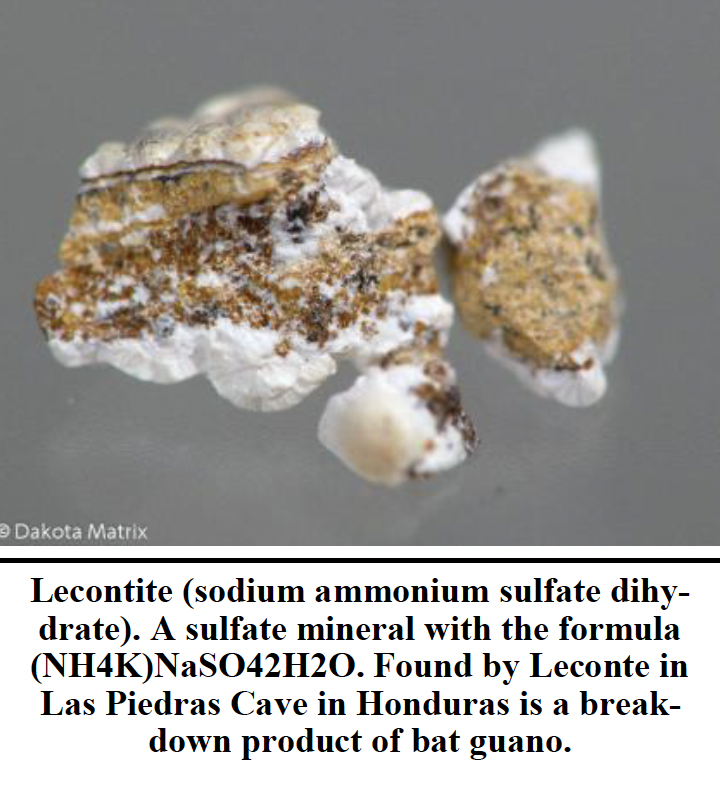
In the 1850s, LeConte collected some crystals from a cave in Honduras being mined for bat guano. It was later found to be a new mineral that was named “lecontite” in his honor.
Lawrence’s Goldfinch
Lawrence’s Goldfinch (Spinus lawrencei) is a small, grayish songbird found mainly in California and northern Baja California. Unlike the bright yellow American Goldfinch, males of this species have a soft gray body, a yellow patch on the breast and wings, and a distinctive black face mask, while females are plainer and lack the mask. They favor dry open woodlands, chaparral, and weedy fields, often near water, and are known for their irregular movements—populations can appear in large flocks one year and be scarce the next. Their tinkling, bell-like calls give them a light, musical presence in the landscape.
Lawrence’s Goldfinch was named after George Newbold Lawrence (1806– 1895), an American businessman and amateur ornithologist from New York. Lawrence spent most of his professional life as a businessman in the importing trade, but his passion was ornithology. Though an amateur, he became one of the most respected American ornithologists of the 19th century.
Lawrence was a close friend and collaborator of John Cassin and Spencer Fullerton Baird, two of the era’s leading ornithologists. He specialized in studying and classifying bird specimens, with particular emphasis on flycatchers. His careful work helped describe many new species from the Americas, especially Central and South America, based on specimens sent to him by explorers and collectors.
Over his lifetime, Lawrence published around 120 scientific papers and contributed extensively to Baird’s monumental Birds of North America (1860). He was also a founding member of the American Ornithologists’ Union.
Hammond’s Flycatcher
Hammond’s Flycatcher (Empidonax hammondii) is a small North American tyrant flycatcher, distinguished by its gray-olive upperparts, pale underparts with a subtle yellow wash, and a proportionally short, dark bill. It breeds primarily in montane coniferous and mixed forests across western North America, from Alaska and British Columbia southward into the Rocky Mountains and Sierra Nevada. During migration, it moves through the western United States to wintering grounds in Mexico and Central America. Hammond’s Flycatchers is especially difficult to identify, complicated by its similarity to other Empidonax species, though its relatively long primaries, inconspicuous eye ring, and characteristic high-pitched vocalizations are reliable field marks.
Hammond’s Flycatcher was named after William Alexander Hammond (1828–1900) an American physician, neurologist, and military officer. He served as Surgeon General of the U.S. Army during the Civil War (1862 – 1864), where he helped modernize military medicine and founded the Army Medical Museum, which later became part of the National Museum of Health and Medicine. After leaving the army, he became a pioneering figure in American neurology and psychiatry, writing influential texts on nervous system diseases and helping establish the American Neurological Association. Though medicine was his main field, Hammond was also a friend and supporter of naturalists, including Elliott Coues, who named the flycatcher after him in 1856.